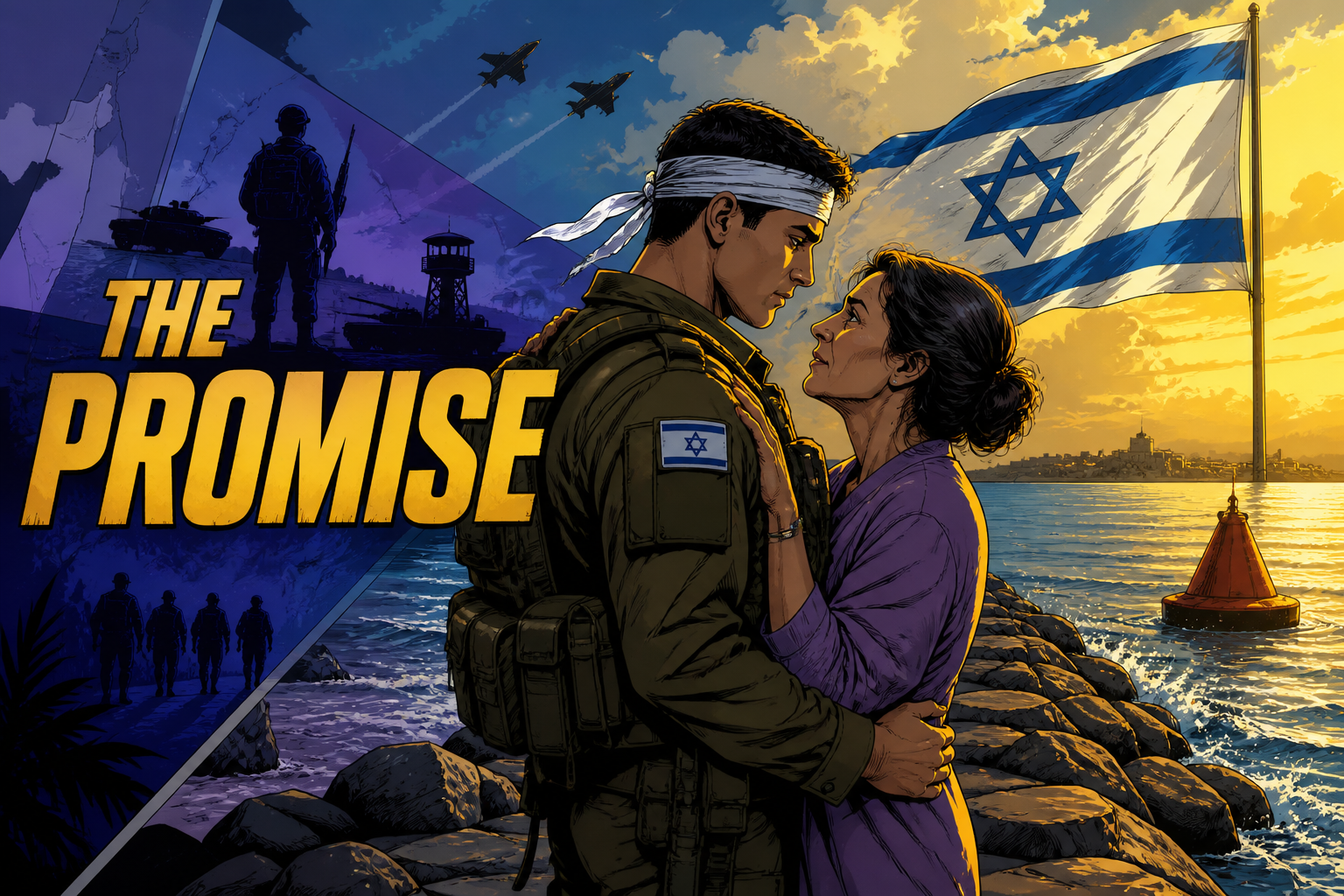
Yellow Star Films hero artwork
This is where it starts. THE PROMISE is the only project currently raising funds — based on a true story, lived rather than imagined.

THE PROMISE is my promise to my mother, from her proud mama's boy. On her deathbed, all she ever asked of me was to be a mensch. My mother was dying of ovarian cancer through most of my adolescence, and I spent those years by her hospital bedside instead of anywhere else a teenager is supposed to be — holding her hand, singing her the Yiddish lullabies she used to sing to me, easing what the medicine couldn't. In the hallways of my own school, at the same time, I was being bullied for being Jewish — two wars, fought in the same breath. I created an alternative ego, SexyHeeb, who wasn't built to survive one of them. He was built to survive both: tough enough to take the hits at school, tough enough to hold what I couldn't say out loud about losing my mother.

When she died, what SexyHeeb protected me from changed. It wasn't bullies anymore — it was the emptiness, the abandonment, the yearning for a mother I could no longer reach. Somewhere inside that grief, I kept coming back to my family's trips to Israel when I was a boy, chasing that same age of innocence I yearned to feel again. I realized Israel was my mother, and I wanted to defend her. That's what took me to Israel, into the Israeli paratroopers, and into a real war — carrying an invented self all the way in, and finding out, standing in the middle of it, whether he was a costume, or who I'd actually become.

My armor. My shield. My sword. A Jewish warrior. My journey told exactly how it happened. It says more about faith, survival, empowerment, and evolution than any argument ever could.
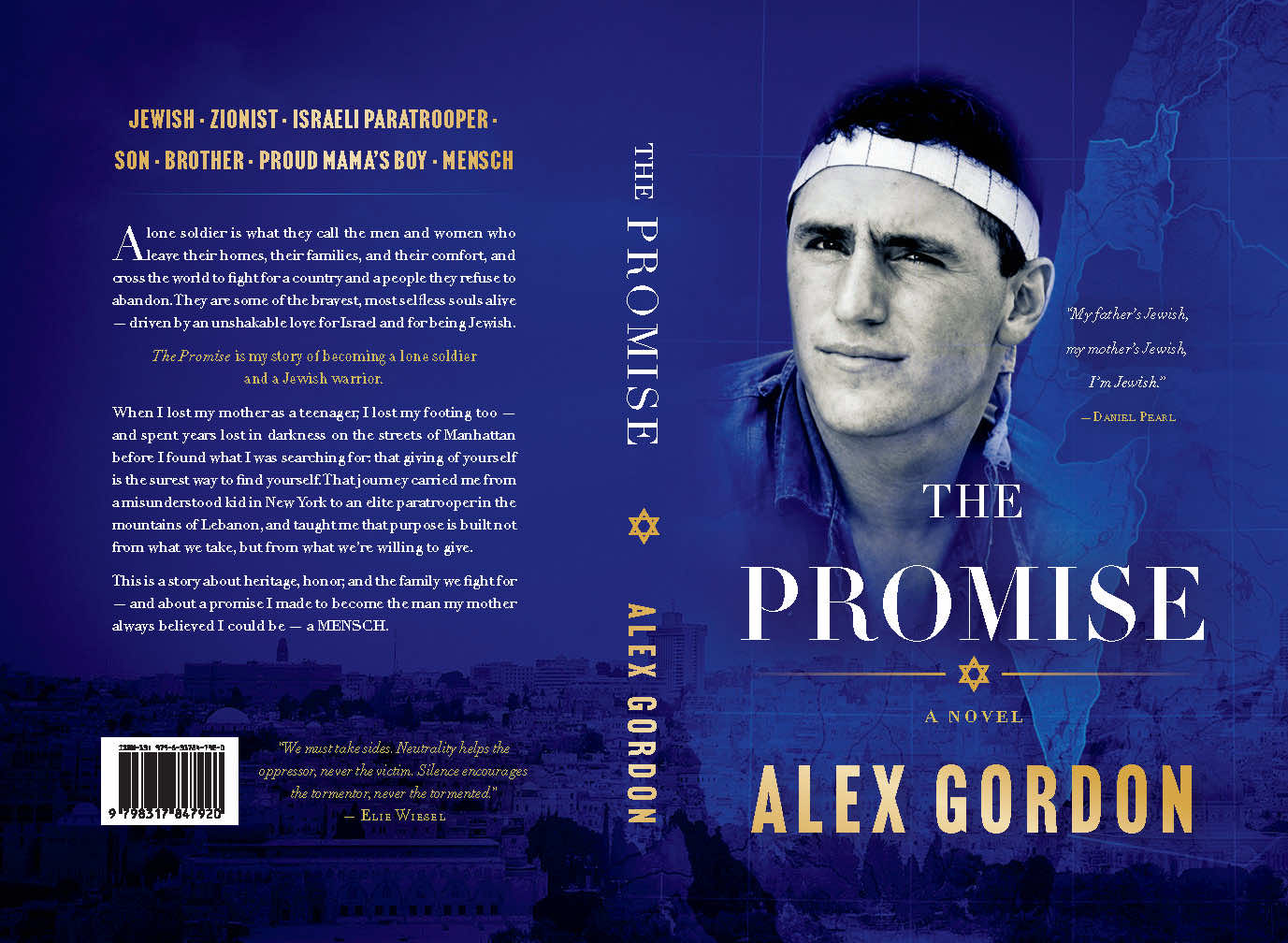
The Book
The Animated Short
a true story by Alex Gordon
Download the screenplay (PDF)
The promise is a story about a story. A true story about vignettes from a …
The Production Company
Black Sheep production company logo

Founded in 2010 by Saar Yogev and Naomi Levari, Black Sheep was born out of a shared belief in deeply felt, character-driven storytelling and in the power of close, meaningful collaboration.

With titles premiering at Cannes, Berlinale, Venice, Toronto, and Series Mania, Black Sheep has earned international recognition for its feature films, creative documentaries, and drama series. To date, the company’s productions have received more than 100 awards worldwide and have been embraced by both audiences and critics.

Black Sheep focuses on stories that bring unheard voices to the forefront, working hand in hand with selected creators and production partners while staying deeply involved in every stage of the filmmaking process.

For Black Sheep, filmmaking is first and foremost a shared human experience.

The Author
JEWISH · ZION IST · ISRAELI PARATROOPER · SON · BROTH ER · PROUD MAMA’S BOY · MENSCH

A lone soldier is what they call the men and women who leave their homes, their families, and their comfort, and cross the world to fight for a country and a people they refuse to abandon. They are some of the bravest, most selfless souls alive— driven by an unshakable love for Israel and for being Jewish.

The Promise is my story of becoming a lone soldier and a Jewish warrior.

When I lost my mother as a teenager, I lost my footing too — and spent years lost in darkness on the streets of Manhattan before I found what I was searching for: that giving of yourself is the surest way to find yourself. That journey carried me from a misunderstood kid in New York to an elite paratrooper in the mountains of Lebanon, and taught me that purpose is built not from what we take, but from what we’re willing to give. This is a story about heritage, honor, and the family we fight for— and about a promise I made to become the man my mother always believed I could be — a MENSCH.
The Promise
a true story by Alex Gordon

I was sitting in my favorite bar in Manhattan doing two of my favorite things, drinking and writing. I was writing a screenplay about my mother, who was my world—beautiful, funny and strong—but who got sick when I was 11 and died from ovarian cancer when I was 17. I was writing about our annual family trips to her beloved Israel, trips we took until she got sick. And I was writing about the emptiness, loss and confusion I felt after she died that led me to go to Israel to find her. Which is how I ended up taking dual citizenship and becoming an Israeli paratrooper to honor her and protect the country she so loved.

The drinking was to help me remember and write it all down. It was also to help me forget: the suffering my mother endured the last years of her life; the young woman, Dafna, I loved and left in Israel; a fellow soldier, Do-Dee, who became like a brother to me but was killed in an attack; and the insanity of the Israeli-Palestinian conflict that brought so much pain to all.

Around midnight, when the drinking became a lot more than the writing, I stopped both. Then I gathered up the pile of journals and notepads I had written in by flashlight over two years of nights in the barracks. Hundreds of pages of stories about my mother, my growing up and my experiences as an Israeli Paratrooper. I stashed them and the 90-some pages of the screenplay I was writing by hand into an oversized backpack that I carried them in always. I strapped it over my shoulders, feeling that my whole life and everything I cherished was in that black knapsack.  

Drunk and stumbling, I left the bar and hailed a cab. When it stopped, I jumped into the front seat and started a conversation with the driver. He at first objected to me sitting in the front, but then relented. I asked him about his family. We shared stories and developed a bond. I told him I was a mama’s boy and missed my mother dearly. He said he understood, that he too had a strong love for his mother. Then he asked what was in my bulging knapsack. Precious cargo, I said. A screenplay about my mother and my experience as an Israeli Paratrooper. That’s when the mood of the cab changed dramatically. He told me his name was Muhammad and he was a Palestinian.

The next twenty blocks were filled with us yelling our partisan bullet points at each other and cursing at the top of our lungs. The profanity and expletives coming out of our mouths were shameful. I was dropped off in front of my brownstone and got out of the cab. We exchanged our last curses while I slammed the door behind me. But as I watched him speed down my block, I suddenly panicked. I had left my knapsack in his cab—my stories, my screenplay and all my notes, the only copy! I started running down the street, yelling in desperation. All of my characters pressed their faces against the back window of the cab as we tried to reach each other. I screamed and yelled as I ran.


Stop!


The cab reached the end of the block and turned the corner. It was about 1 a.m. in the morning and it started raining (of course). I was beside myself, wasted, desperate and lost. The rational voice in my head told me to relax and go upstairs to my apartment. I refused, knowing the cabby had no idea what apartment I lived in. Loaded and soaked, I lay down on my stoop and for lack of a better idea, I prayed.

After an hour I was close to giving up and going inside, but I just couldn’t. In that cab was my mother. That story was my life. I imagined all my characters frightened and pleading with the cabby to come back to me. At that moment a yellow cab came down my block and pulled up in front of me. It was my cabby!  The back door swung open and all my characters, my family, jumped out and hugged me.

Overwhelmed with emotion, I started crying. Yes, I’ll say it, I was crying hysterically and shaking. Muhammad was standing outside his cab in the rain holding up my knapsack in both of his hands. As I moved toward him, he told me he hated me. I told him I hated him too, and then we both embraced in the greatest hug of my life. I didn’t want to let go. I just kept thanking him from the bottom of my heart. Then I asked him why, after all the nasty things we said to each other, he came back. He told me that after turning the corner, he got a customer who was going down to the East Village, far from my apartment on the Upper Westside. That’s when he noticed my black knapsack in his front seat, and his first instinct was to lower his window and throw the knapsack out. But after he dropped off his new passenger, he turned off his “on duty” lights and made his way back to me.


He said he came back because I asked him questions about his family and because he shared the same love for his mother that I have for mine. We disagreed on everything, but agreed that the love of a mother is everything. As I listened to his words, I couldn’t stop crying. He made me promise that my story of my mother would be heard. I promise Muhammad, I promise, I said. He then made me promise that our story would be heard too. I promise, Muhammad, I promise, I said.
I always keep my promises.